Monday, January 6, 2014

A Brief Message to Mothers

I have been thinking about this post for a while now, ever since my friend Vanessa sent me this amazing poetry video. It is not very long but is wonderfully insightful. Please watch it!


I have toyed with the idea of a post devoted to mothers for months now. Finally, I have decided to write it today on my own mother's birthday.

You may wonder what qualifies me to give advice to mothers since I am not one. I have a mother though and so I consider myself an expert. It is my belief that parenthood is the most important job in the world. Parents call their children their greatest accomplishments. They say that raising children is the most fulfilling thing they've ever done. This is not what I am referring to.

I am talking about saying things to Austin that I've heard my mother say to my dad. I refer to my love of fantasy and science fiction, my taste in music, my anxieties, my obsessive organization, my writing skills, my love of books and British television, my aversion to spicy foods, my devotion to crocheting, my belief in education, my open mind and overflowing heart. I refer to the essence of myself, all of which can be traced to one of my parents.

I am me because my parents are who they are. I might have been different. Austin might have been different. My nephews might have been different. The whole world might be different based on what parents taught their children. This is why I consider parenthood the most important job ever: because parents make the world what it is.

So mothers have to be careful what they teach us. Obvious, right? But I think our mothers have missed something. This is not directed at my mother but all of them, including the one I hope to be someday. It's not enough to teach us that we are beautiful and perfect and loved just the way we are.

You have to teach us that you are beautiful too.

The older we get, the more we become like you and I, for one, celebrate this. It gives me courage and confidence. Because I am like my mother, there is hope I will achieve all that I want to. But there is danger too. Will our mothers teach us that we are perfect now but we are destined to be made ugly by aging? Will my body be destroyed by my own future motherhood? We learn in our youth that every birthday is an important one because we are always worthy of celebration. Mothers, will you teach us that, at a certain age, we should not celebrate getting older anymore?

Mothers, assure us that we will not one day lose our self-worth.  Teach us that we will always be beautiful and perfect and just the right size. Teach us that it will always be more important to be smart and kind than thin and feminine. Teach us that another candle on the cake is something to be grateful for because life is a blessing.

Please.

Teach us that you are beautiful so we can believe that we will be too.

Tuesday, October 22, 2013

Counting on Two Hands


I thought I'd open a post about anxiety and depression with a little
Supernatural humor. I like to think I'm like Sam: being "troubled"
only makes me more awesome!
An hour after publishing my last post about our irrational ideas about our own beauty, I found myself deep in conversation with my friend, Chris. Chris told me about his own battle with academic-induced anxiety. He told me about sitting on his bathroom floor shortly after starting a master’s degree and feeling literally as if the walls were shrinking. He called his mom, and he went home. Chris has since completed an MA in history and is working diligently on his PhD at Auburn, which is how I know him. Even so, he felt a similar anxiety his first semester of his PhD program, primarily because he had no idea how he was doing in one of his classes. He has since realized that, had he been doing poorly, someone would have made him aware of the fact. And I thought about what I wrote about depression and anxiety in my grad school follow-up post – that it makes you feel alone – and I realized it required an addendum.
 
Depression and anxiety make you highly irrational.

I started taking medication and seeing a counselor for generalized anxiety when I was in high school, but I can trace it back to a decade earlier. I distinctly remember, as a kindergartener, being afraid to ask the teacher if I could go to the bathroom. It was partially shyness, but the main problem was that I wasn’t sure if I should say “bathroom” or “restroom”. I had heard it called both, and I didn’t want to say the wrong thing to my teacher. Similarly, my parents picked me up in the middle of the night from countless sleepovers and church camp outs. I would stay the whole night at a relative’s house only if my big brother was there too. Even then, it wasn’t as simple as a phone call: “Come get me!” It was an agonizing process. I never simply admitted that I wanted to go home. I came up with what seemed an appropriate excuse –  I wasn’t feeling well or I couldn’t sleep – something that I thought would appear more reasonable to my disappointed host than “I’m homesick because I’m a child and we do that sometimes.” Of course, I understand that children are not the most rational of beings. They haven’t learned how the world works yet or that children can get away with saying anything at all. But my anxiety, perhaps based in a child’s timidity, was exacerbated by the desire to be well-thought of, a desire that long-outlasted elementary school.

I joined my high school’s newspaper staff because I thought I liked writing. My first article was well-received, which made me happy until it came time to write a second one. What if I couldn’t write anything as good as the first one? Making good grades on tests had the same effect: a high “A” was all well and good until you realized there was nowhere else to go but down. I loved being considered smart, but I lived in fear of someone finding out it wasn’t true.

Every time I moved somewhere new, where there were presumably no expectations of my intelligence, I thought I would be different. But I fell into this pattern again, to an even greater extent, when I went to college and finally graduate school, where it culminated in a near inability to look my professors in the eye because I was sure I must have done something disappointing.

Shall we analyze the irrationality of these situations? First of all, the only time one should be that stressed about high school or college, for that matter, is if one is making poor grades. (I don’t mention graduate school here because I gather that it is highly stressful even for the perfectly rational and mentally sound.) Second, there was no truth for anyone to discover. I’m not the “makes-good-grades-without-trying” type that we all know and hate, but I’ve always been a good student and a good writer. Even if I did poorly on a paper or test, it’s not a statement about my value as a human being.  

My anxiety has never been solely related to school, however, though that has always been a source of great stress because of the importance I have placed on academics (I’m Hermione, remember? Plain but clever). When I started driving, my anxiety increased dramatically, I suppose because I was expected to navigate the world without the buffer of my parents or older brother. I didn’t like putting gas in my car because pay-at-the-pump can be confusing, but paying inside required human interaction. Shopping alone was a traumatic experience. It is often hard to find what I want, and I feel perpetually in someone’s way. I feel guilty when I forget my reusable bags and like I’m inconveniencing the cashier when I bring them. There is a moment of fear every time I swipe my debit card, even if I know exactly how much money is in my account. Phone calls from numbers I don’t recognize frighten me: did I forget to pay a bill? Did something bad happen? And whenever someone says, “Come see me after this” I spend the entire class or meeting going over what I might have done wrong.

I assume that you recognize the irrationality in all this because even I can. I recognized it even as I was doing it, but here’s another addendum:

Like cigarettes and chocolate, anxiety is habit-forming.

Without even knowing I was doing it, I built my life around avoiding situations that made me anxious: I didn’t drive on the interstate, I didn’t pump my own gas, I didn’t go to the grocery store alone, I didn’t answer questions in class, I didn’t join extra-curricular organizations unless someone asked me to in which case I didn’t say “no”… Until the idea of having anxiety made me as nervous as the situations that caused it. I’ve had the same recurring nightmare from the time I was eighteen until a few months ago. While the details change, I have always forgotten to write a paper until the night before it is due. I completely freak out. It is the middle of the night, and I am alone with my panic. Basically, my recurring anxiety dream is about having severe anxiety.    


What can I say? It happens to the best of us.
Of course, people told me this way of thinking made no sense. But you know how married people talk about falling in love and they say, “When it happens, you just know”, and you think you’re going to be the one person in the world who doesn’t “just know” and are, therefore, going to miss the marriage boat? That’s sort of what it feels like. People told me that the world is not actually that frightening of a place. They said that no one is paying that much attention to what I do. They told me it doesn’t matter if I mess something up on occasion. And I knew, in my head, that they were right, but I felt like those were rules that applied to their life, their world, not mine. These were people who spoke without thinking and drove to Atlanta and back in the rain.

I was so afraid of disappointing people that I became an expert at figuring out what they wanted to hear and saying it. And people liked me, which is what I wanted, but I feared that maybe they didn’t really know me: that the person they liked was someone I had invented. Until I couldn’t tell which version was me and which was invented. I couldn’t tell the difference between what I wanted and what I thought other people wanted for me.

But the absolutely worst part of it was that I really believed that was just how it felt to be me. I did make a couple of efforts, mostly in college, to reinvent myself and the person I wanted to be. But by last year, I had accepted that this was who I was. I had come to define myself to myself as nervous, high-strung, cowardly, and close to only a privileged few. There was a time when I could count the number of people I wholeheartedly loved and opened up to on one hand. I thought I was going to feel like that and be like that for the rest of my life. I thought I was going to ruin Austin’s happiness by dragging him into it.

I repeat: anxiety and depression make you highly irrational.

I definitely am not trivializing anxiety here or suggesting it can be turned off like a switch. It can’t. But it doesn’t last forever. I promise it doesn’t. I’ve been anxious and depressed for a long time before, but I’ve always been happy again.

I feel so much better since leaving school, and not simply because of the academic stress. I’ve mentioned before that the act of quitting gave me courage, but it did more than this. I feel as if I walked around with a veil over my face that showed people what they wanted to see, but when I took it off they still loved me. And for the first time I could see how silly it was to think they would judge the choices I made about my life.

I’m still anxious every day. I still often don’t sleep well. I still get nervous when the phone rings. I agonize over sending emails at work. I had my first post-graduate school “freak out” as a result of car trouble that I thought was going to interfere with my job. I didn’t feel properly me again for three days. On top of the familiar anxiety was a feeling that I’d failed or relapsed. But do you know what’s really strange? It’s been two months since I’d really panicked and, until then, I’d nearly forgotten what it felt like.
A little advice for keeping anxiety at bay.

That’s fine with me.

I didn’t make a conscious effort to put that behind me when I left grad school because I honestly didn’t think it was possible. Now I know that I can deal with it. I’ve learned that I can keep it at bay with a haircut and a purpose: I joined a book club, volunteer at a library, write a blog, join service Saturdays, take vegan cooking lessons, and go out with friends. Still, every time I am confronted with something I am nervous about doing (which, let’s be honest, is still at least 5 days a week), I think about putting it off. Anxiety is habit-forming. And then I think, “No. I’m not going back there.”

I wanted to write this post partly as encouragement because I so remember thinking it was forever. And it wasn’t. But there is another reason too. As Chris and I discussed our experiences, he told me he wished he’d known how I was feeling last year so we could have talked about it then. A year ago, I never would have told him. I was obsessed with being liked and I didn’t see what about my neurosis was likeable or even acceptable. So I spent years trying to hide that I hate driving and that writing papers terrified me. Since I opened up in my grad school post, I’ve talked to a lot of people and a lot of conversations have started with “I don’t tell people this, but…”

The truth is, I would not relive that level of anxiety for anything – not even if it was my only opportunity to travel with the Doctor in the TARDIS. But now that it’s over, I’m glad it happened. I’m glad I know what it feels like, and I’m glad I get to talk about it. Because by not talking about it, we send the message to ourselves and others needing encouragement and support that there is something wrong, even shameful, about the way we think and feel.
I kind of wish the Dowager Countess narrated my life.

So the facts are these: I am high-strung. I ask an annoying number of questions because I’m terrified of screwing up. I hate driving in the rain. I don’t do roads with more than 4 lanes. I’m shy at first but once you know me, I’m hilarious. I have no sense of rhythm but love dancing. I hate shopping alone, but I do it. I find inspiration in stories, fictional and real. I love history but have a terrible memory. I find people fascinating. I have strong opinions that may or may not mesh with yours: it’s okay with me if it’s okay with you. This is me, and you can take it or leave it.  

And since I’ve accepted that people will either like me or not, I have found myself so much more open to them. I’m not thinking so much about what will make me more impressive to others. Honestly, I think I’ve always liked people, but I used to be afraid of their judgment. Now I see an opportunity to hear stories, to learn, to connect with my world. I know that the anxiety will probably always be there, in the back of my mind, waiting to creep up to the front of my mind. But I also know that I can handle it and still be happy as long as I keep saying, “No. You are not welcome here.”

And since accepting this, the people I love can't be counted on two hands.


Friday, October 18, 2013

Be Rational, People


The idea for this post (parts 1 and 2) came from my friend Mike, and has since grown into a monster that I’ve sat down to write at least seven different times. Mike and I worked together at the Auburn University library over the summer where we bonded over a mutual love for science fiction and fantasy. Among other shows, he told me about the show Warehouse 13, which he particularly liked for its strong female character, Claudia. He considers Claudia, a resourceful and tech-savvy inventor, a good role model for his teenage nieces. “Who else do they have?” he asked. “Paris Hilton?” Mike’s nieces sound like pretty awesome young women already, but I think he brings up a relevant point.
Claudia, from Warehouse 13

I started writing this post in my head months ago and, at that time, it had a clear thesis. I have since lost all concept of what it is actually about and where it is going. But it’s my blog so I’ll ramble if I want to, right? My conversation with Mike led me to poll my friends about their favorite female role models in books, film, television, and comics. So I started compiling a list that included Hermione Granger (Harry Potter) Anne Shirley (Anne of Green Gables), Scout Finch (To Kill a Mockingbird), Eowyn (Lord of the Rings), J.K. Rowling, Oprah Winfrey, Ellen DeGeneres, and Jennifer Lawrence.

And one metaphorical can of worms was opened after another. First of all, we couldn’t all agree and some delightful analysis of fictional women ensued. Apparently, we should have all been lit majors. It is no secret that Hermione Granger is my personal heroine, but my sister-in-law pointed out that, though Hermione is a positive role model, she often plays second fiddle to Harry. Similarly, some people thought The Hunger Games’ Katniss was an example of a strong, brave young woman who became the face of a revolution. Others felt that she lost this persona in the second and third books after suffering various traumas. The media hype surrounding the films portrays the story as a love triangle, and I love the below response to that.

Going off on a tangent here, but I don't understand love triangles. How does one romantically love two people at once? Sherman Alexie describes my feelings exactly: "He loved her, of course, but better than that, he chose her, day after day. Choice: that was the thing."
I came across the second can of worms – in the form of this infographic – while scouring the internet for fictional female role models. I admit that it has some troubling character/plot inaccuracies. The title alone, however, brings up an important point: “Why do all the girls who save the day only look a certain way?” Basically, the author asks why popular heroines are all “white” and shy. I believe Suzanne Collins actually describes Katniss as having olive-toned skin, but she is portrayed in the films by the light-skinned Jennifer Lawrence (whom I adore, by the way). All the other heroines are, in fact, “white”.

(Another tangent: I use “white” only because I can’t think of another word. Caucasian suggests these heroines hail from a mountain range in Russia so that doesn’t work either. I am bothered by the use of “black” and “white” as descriptors, though because 1) they are colors, not descriptions of ethnicity, and 2) they are not even accurate as we are all just varying shades of brown. My five-year-old nephew came home from kindergarten and told his mother “Some kids at my school have light brown and dark brown skin. Our skin color is bright brown.” When his mother explained that his skin color is called “white”, Preston exclaimed “What? We’re not white! We’re not Voldemort!” Children are the best social commentators.)

"When I was nine years old, Star Trek came on. I looked at it
and I went screaming through the house, 'Come quick! There's a
black lady on television and she ain't no maid!' I kew right then
and there I could be anything I wanted to be." - Whoopi Goldberg
Revenons à nos moutons…The author is making his point about the scarcity of African American heroines specifically in film adaptations of popular books. I wonder if authors tend to write characters that resemble themselves, and writers probably fall into the quiet bookworm personality spectrum. So the real question, perhaps, is why are we not reading best sellers written by African American women? It really bothers me to present a question and not provide a solution but I don’t have one. I would love recommendations though!

Austin opened the third can of worms by informing me that men are people too. I suspected it might be true, but now
I’m sure. I feel that my previous post provides too simplistic a discussion of body image and media. For one thing, a number of the men I know are also concerned about sexualized media portrayals of women. They don’t buy into the “beauty” stereotype and are offended when television and film portray men as doing so.

But even beyond this, media portrayals of men also affect how they see themselves. My friend Kacey recently attended Dragon Con with her husband and commented that “plenty of men there were looking on their buff-tastic fellow geeks cosplaying their favorite characters with body envy.” Male super heroes and members of the Enterprise crew also wear skin-tight uniforms. Most male heroes (in visual media) are portrayed as very fit and physically strong. The general feel I get from this is not sexualization as much as a show of strength. My dad suggested that it is not so much an issue
of physical objectification. Rather, each gender is presented in their stereotypical ideal. According to these “ideals”, sexy = feminine and strong = masculine

This = Untruth

So, why don’t I hear much about how media representations affect men? Are women more sensitive to social pressures? Does society train us to believe that stereotypes about men are true while those about women are not? Surely, it is as great a concern: boys should not be made to feel “unmanly” because they don’t look like Thor.

The last can of worms (which no doubt Preston would inform me is a disgusting and not very vegan-friendly metaphor) almost prevented me from publishing this post. It is that I am a huge hypocrite. I complain about these stereotypes and simultaneously consume the media that perpetuates them. For example, I like to listen to Pandora’s Dance Cardio radio station when I exercise, and I don’t think there is a song on that station that does not objectify the female body. It’s not the message I’d like to send, but it serves the purpose of getting me pumped up to suffer.

Then there is my newfound devotion to the show Supernatural. I love the series, but the main characters (two 20-something brothers) are often depicted using their good looks and fake badges to gather information (and a phone number) from a scantily clad barmaid. In spite of this, the show actually has many of the positive themes found in some of my favorite books like Harry Potter or The Lord of the Rings: family, loyalty, courage, and free will all set against the backdrop of an epic battle between good and evil. So, should I feel guilty about watching a show where this is fairly standard dialogue?

I’m going to say "no", and my blog means my rules. What I actually need (rather than guilt) is greater media literacy and a better grasp on reality. I say this to partially poke fun at my love of all things outside the realm of believability (time-traveling alien, demon-fighting siblings, school for wizards and witches...), but it’s also really true.

Example: I have devoted a large chunk of the last five to seven years of my life to writing. I am told that I am good at it, and I desire to be good at it, but I do not believe myself to be good at it. I mean, I’ve written enough "A" papers to know logically that I am, but I don’t believe it. When I write, I get nervous, I have an irrational fear of accidental plagiarism, I obsessively reread and re-edit papers I already turned in. People told me over and over again that I wrote well, but I thought they must have missed something. Then, I recognized the irrationality of that thought and feared I might be mentally unstable.
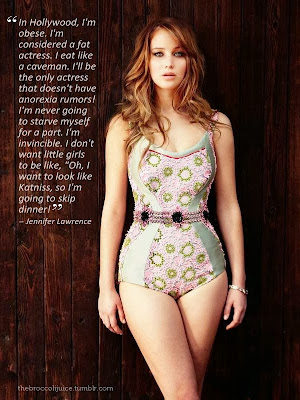
The jury is still out on the latter, but if I'm crazy then so are a lot of other people. Because there are, apparently, doubts about this woman's physical beauty. What I am trying to say is this:

There's nothing wrong with liking books, movies, or TV shows, but it's not real. And I don't mean the part about dragons and magic. While no doubt they come from somewhere, the stereotypes are not real. Masculinity and Femininity cannot be simply defined and nobody is just one thing.

and this:

We look at ourselves and we can't see that we are beautiful. We see fat and flaws and we're not even looking at what our real value is. We spend so much time looking at ourselves that we don't see what other people see. And that is just crazy.

When Austin and I were still in college, he decided to take me out to dinner after a hard week. We were broke so this was a big deal, and I grinned and gave him a hug. He looked at me and said, "You look so pretty right now." I was so stunned, I remember actually looking in the mirror to see what I looked like. I was wearing jeans, a baggy purple t-shirt, no make-up and a crooked pony tail. "How?!" I demanded, and he said, "Because you love me." (Yes, he actually says things like that. It's like living in a movie.)

Be rational, people: look at yourself and see what the people who love you see.


Sunday, September 1, 2013

Your Body is a Miracle (Part I)


According to a 1997 study of 3,452 women, 89% of women want to lose weight. In addition, the relentless pursuit of "thinness" is considered normal female behavior in Western society as "thinness" has come to represent attractiveness, self-control, and even success. It seems unlikely that we are born with the belief that being thin is a requirement for beauty. For most of human history, being thin (and by thin, I mean emaciated) was simply the only option and being heavier was a sign of affluence.

If we're not born with it, when do we learn this mentality?

Marie C. claims here that 53 percent of girls say they are unhappy with their bodies by the time they reach 13. Unfortunately, she does not say where this statistic comes from, and I was unable to confirm it. Whether or not the percentage is accurate, however, it inspired a really interesting project. Marie interviewed and photographed children under the ages of 10, asking them a simple question: 

"What do you like about your body?"

The responses are childlike, funny, and generally adorable. Just read what six-year-old Bayan wrote: "I like that eyelashes are long. I like that my skin is half white and half brown. I like that my hair can shake." But they are also incredibly practical. Nine-year-old Lana likes how fast she can run and how healthy she is while six-year-old Laila likes her hands because they help her draw.

Eight-year-old Jeniah lists the amazing things her body lets her do
The whole experiment is summed up by five-year-old Lola who wrote, "I like my body because it's magic." Sure, it's another one of those cute things kids say, but it's also true. I'm a John Mayer fan, but he got it wrong when he said "Your body is a wonderland." Our bodies are, at the very least, incredibly complex pieces of machinery and, at the most, downright miraculous.

As I type this, I can't help but think about a ten-year-old boy that I babysat for once. Thomas had a much-needed kidney transplant in January, but his family just learned that his rare kidney disease has returned and is attacking the new organ. As I think of gangly, grinning, beautiful Thomas I am ashamed that I ever considered my body anything less than perfect.

What happens? Why do we stop thinking of our bodies as the miracles that they are?

It seems logical that girls first learn to love or hate their bodies from their mothers. In fact, I started this blog in response to Kacey Edwards' open letter to her mother, found here. To recap briefly, Edwards wrote that she learned to have a poor self-image from hearing her mother talk negatively about her own body. She calls on her mother to help show her three-year-old daughter that beauty will not be her most important attribute. It is a wonderful goal, but one I fear they cannot accomplish alone. Because, eventually, girls are old enough to read books, watch television and movies, play video games, and go shopping with friends, and they learn, based on these media portrayals, that girls and women "should" look and act a certain way.

women in video games
About Face is a nonprofit organization focused on media literacy. Their goal is to educate girls and women so they can resist media messages that affect their self-esteem and body image. According to About Face, high exposure to mainstream media in young women is associated with a stronger emphasis on physical appearance. In addition, girls and young women who consumed more mainstream media also more readily accepted the stereotype of women as sexual objects. This affects women more than simply physically. In a 1998 study, college students were asked to try on either a swimsuit or a sweater. While wearing the garment, they took a short math test, and the women wearing swimsuits scored significantly lower. There were no differences in the men's scores. The creators of the study suggest that thinking more about one's body - and comparing it to sexualized cultural ideals - disrupted these young women's mental capacity.


Hattie Hooker Wilkins
I just finished typing the Encyclopedia of Alabama entry on Hattie Hooker Wilkins, the first woman elected to the Alabama Legislature in 1922. When asked why she ran for office, Wilkins explained that, because the population consisted of men and women, it should be represented by both genders. Surely, the same is true of media. In fact, male protagonists in television and film are much more common. Of the female characters who do appear in sitcoms, three-quarters are underweight. Similarly, in the film industry, body doubles are often used for actresses who don't meet the requirements of an idealized female body. Young adult fiction revolving around a female character usually incorporates a romantic interest, often a love triangle. Of course, romance is an important part of a girl's coming of age, but surely the same is true of boys.

Even within "nerd" and "geek" culture, which claims to have the strong female characters that popular culture ignores, women are still often marginalized. Women are often considered less "legitimate" nerds than their male counterparts. The reason is not entirely clear to me though I think it is linked to a (false)assumption that women don't read comic books or play video games. My personal "geekery" tends to stay in the domain of fantasy, science fiction, and history books and the BBC. However, many women obviously do enjoy these activities, and some of them put together this great message:
The CEO of Yahoo, Inc.! defined geeks as "people who love something so much that all the details matter." We wear the title like a badge of honor, but the women who develop in-depth theories about how Sherlock survived Reichenbach are summarily dubbed "fangirls". Then, of course, there's the issue of sexualization and body image. Apparently, women prefer to save the world in a bathing suit or, occasionally, in their sexiest underwear. It's not easy for a self-conscious girl to cosplay as her favorite character.
 
If media (popular and geeky) teaches both men and women that we're supposed to look and behave based on a sexualized stereotype, what are we supposed to do? Should I refuse to let my future daughters (and sons while we're at it) consume certain books, shows, and movies, some of which I deeply love, for fear they'll have a negative self-image?
 
Of course not! Fortunately, for me and them, there happen to be some excellent role models in the media, from fictional characters to authors to talk show hosts. I am currently working on a post devoted solely to a list of these role models, and I plan to have it up in a couple of days. As you tell your daughters about Bella and Wonder Woman, I hope they'll also meet Hermione, Katniss, and Anne Shirley. 

Saturday, August 24, 2013

A Lightness About You


I just got home from the Auburn history department's graduate student mixer where I was welcomed and hugged. And I replaced my plans to write a post about female role models in media for a brief follow-up on my decision to discontinue my graduate program.

I wanted to do this for two reasons. The first is to say THANK YOU. I have been so overwhelmed by the positive response to my decision and my post. I had some anxiety about telling people, but I promised myself that, no matter how nervous I felt or how anyone reacted, I would not act as if I am ashamed or I have failed in some way. Because I'm not and I haven't, even if some people thought otherwise.  In fact, most people, when I explained my reasoning, agreed that I made the best choice for my own health and well-being. They were just glad that I made a decision that makes me happy and hope it will make me a more social creature.

Of course, there have been a couple of people who have considered it a financially unsound decision as withdrawing from school (which provided me with a monthly stipend) was the equivalent of quitting my job. Once I even heard, "There's not much money in social work or libraries" (as if historians are rolling in cash). I admit that these instances made me angry, but they also taught me what it really meant when Atticus Finch told Scout to stand in someone's shoes and walk around in them for a while. I can see what this looks like from the outside, but I also know that on the inside it feels right. And the people who matter can see that too. It felt amazing to hear my friend DG say, "There's a lightness about you that I don't think I've ever seen before." And he's known me since I was an undergraduate.

I felt most validated, however, when three of my friends told me they shared my post with someone who felt as if their own decision to quit graduate school was a disappointment or a failing. This leads me to my second reason for wanting to post a follow-up.
 

When I told them of my decision, several people surprised me by sharing their own personal battles with academic-related anxiety and depression. All the time I struggled, there were people around me who knew what it was like, and I just didn't know it. Depression and anxiety make you feel alone and isolated. I want anyone who may be struggling to know that it's not true. I promise you that someone else (like me) has felt the same way. And whatever you decide, most will understand and be supportive. Certainly the decision leads to other complications, such as my current unemployment. But I finished a year of graduate school, made the difficult choice to not finish it, and told everyone about it. Honestly, I can handle whatever comes next. And so can you. You have been strong and brave and what you were once you can be again. Let there be a lightness about you.

Saturday, August 10, 2013

How To Quit Grad School and Still Feel Beautiful


Me: Yeah! Like he would have died many times
Austin: Or he would have died once and that would've been the end of it

In high school, Hermione was a sort of talisman for me. I considered myself the "plain" friend, the one who would rather stay at home with a book than go out. But I was certain, remembering Hermione, that being smart was better. I expect it is natural for teenagers, in those years before we really know who we are, to select a persona and cling to it desperately. I chose the Hermione persona, and, since I never thought I was pretty, made being intelligent my aim. 

I was good at it, and I liked it. I love reading and learning, and a streak of perfectionism makes me a great, if perpetually dissatisfied, student. I loved college, even as I felt a growing need for every paper to be better than the last. I'm not sure anyone really doubted I would go on to graduate school and do well there. I liked the idea of being an example of a strong, independent woman with a PhD and a family. My professors at LaGrange wrote what must have been glowing recommendations and the French history professors at Auburn advocated to have me accepted and fully funded.

I loved the program the first time I met my fellow graduate students. Everyone had such passion, such curiosity, and finally here was a place where being clever was cool. I still love and admire them. By December, however, I had developed a perpetual ache in my chest that only went away when watching mindless television. I couldn't bring myself even to read novels. My parents said I could choose not to return to school if I didn't want to. But what would I do? Though it strikes me as ridiculous now, I couldn't imagine telling my former coworkers at the LaGrange library who sent me off to grad school with an Auburn cake and orange and blue wash cloths.  

Over the spring semester, I spent a small fortune on doctor's visits and anti-anxiety medication. I probably would not have finished the semester, but my advisor sat me down and helped me make a detailed calendar that made everything less overwhelming. She forced me into a regular exercise and meal routine that worked for a few weeks. I knew by the end of my first year that I wasn't happy, but I had defined myself as "the smart girl" for so long that it felt like a weakness to admit it. My parents and Austin said if I decided not to finish the program, they would support me completely, but I knew they thought finishing was the logical thing to do. I was halfway through a master's program that I wasn't paying for, and I'd be more marketable on the other side of it.

So I complained and cried a lot, but I simply didn't respond when they gave me that choice. It's not just that grad school is hard, though it is. It was a perpetual feeling of uselessness and powerlessness. There was no time for extra-curricular activity outside a trip to the gym, no time for volunteer work. I would get flashes of inspiration for charitable projects, but the first ended in disaster. I got the idea to crochet blankets for nursing home residents without families in the area. Even with my mother's help, it took us until Christmas Eve to crochet ten blankets. I spent as much time crocheting as I spent on homework, which simply added to my stress. Every time I encountered something or someone sad, I wanted desperately to find a way to fix it, and I thought I probably could if I wasn't neck-deep in historiography.

I don't wish to suggest there is something wrong with history as a discipline or my program. I had the best advisor imaginable (really, I dare you to imagine someone better) and good, supportive friends who love what they do. But I quickly tired of the perpetual reading, writing about what I'd read, and talking about what I'd written. I felt like stagnant water. I needed to DO something, needed desperately to feel useful. Which is probably why, in the early days of summer vacation, I started this blog. It was my way to feel that I was encouraging others in the midst of what felt like pointless research.
   
I spent a lot of time over breaks talking to my parents about career options. I decided, once I'd finished my MA in history, I'd probably go back to school for social work, counseling, or library science. It felt like a sort of betrayal because I'd always been a history major, and the idea of pursuing another field frightened me. As a naturally empathetic and sensitive person I feared a more service-oriented career would only depress me.

Then something strange happened. I was at work on July 31st when someone mentioned, conversationally, "I can't believe tomorrow is August," and I started to panic. The end of July meant that school would start back in 22 days. I spent the next several days in a state of depression. A person who has not experienced depression often cannot understand it. Depression is not sadness. Depression is a general lack of feeling: not caring what I ate for dinner or what movie Austin picked to watch. Depression was my defense against my rising panic about the impending start of school, but it didn't last. In the midst of a few panic attacks, my parents and Austin continued to tell me I could choose to leave school if I wished.

But I knew it wasn't what they thought best, and I didn't trust my own feelings about it. I even asked my mother to make the decision for me, telling her I didn't feel emotionally able to be reasonable. Then I realized that I was being an idiot.

I thought I was being brave, being strong, sucking it up and finishing what I'd started. Actually, I knew exactly what I wanted. I just didn't want to be the one to say it. I was waiting for someone to tell me, "Don't go back to school. It's not for you." Because I was too ashamed to make that choice for myself. That, I realized, is not courage. That is merely being passive. I have always had a habit of doing things for the approval of others rather than myself, of trusting the opinions of others over my own. It was past time to trust myself.

Showing off my "power colors"

When I finally expressed what I really wanted to my family and Austin, they agreed it was best. I won't say there was immediate relief as the idea of telling my advisor terrified me. I wanted to wear my "power colors" and scoured my closet for something red. But what I found was even better: a navy blue t-shirt with a picture of the TARDIS that my friend April gave me on my last birthday. My terror was in vain. My advisor is truly a beautiful woman. She told me such a high level of physical or emotional distress was not worth finishing a degree. It was simply my body's way of telling me that this wasn't my path, and I was right to listen to that. I still felt guilty about waiting until two weeks before the start of term to reach the decision, but, with typical wisdom, she said that was just part of the process. I needed the relaxation of the summer and the anxiety related to school starting back to realize what I wanted. See what I mean - the best advisor.

I thought about not posting this. Everyone I love has been informed of my decision and it isn't pleasant to think about those few bad days. But I decided to write it simply because, as weird as it sounds, I decided to quit grad school even though those I trusted most did not think it the most logical choice. And now I feel a sense of relief and peace but also so much stronger as a person. I chose and I was right, and whatever lies before me excites me where it used to frighten me. I look forward to new experiences and new knowledge. I imagine it feels a bit like having all of time and space before me.


Monday, August 5, 2013

"No" Is A Complete Sentence


The historian in me is embarrassed to admit that I do not know the context of this photograph. The avid reader in me, however, likes to imagine the story that it tells. This is the face of a determined woman, a woman who has a mission. It is the face of a woman daring passers-by to contradict her message. "You are NOT Powerless," she tells the people passing her on what appears to be a cold winter's day. Is she telling women they can and should vote? Is she telling passers-by that they have the power to seek social reform for tenement-dwellers and factory-workers? Is she making a holy proclamation about a power that comes from God?

Frankly, it doesn't matter. What matters to me is the message because I believe it to be true. I also love the subtext of this woman's message: You are NOT powerless. And because I stand here in the cold, my jaw set in determination, proclaiming a message that can't be missed, I am NOT powerless either.

This photograph expresses precisely what I attempted to say in my post "Starfish", but I only found it later. My Mother commented about the post, "We should never underestimate the power we have as individuals to lift up - and tear down - our fellow human beings." I am inspired by both the photo and my mother's comment so I wanted to share them. This post, however, is not meant to be a reiteration of a previous one.

I have spent a lot of time lately writing about what we, as women and as human beings, can do for others because it is something I think about a lot. But it is time, for me at any rate, to think about what I can do for myself as well. I have a lot of demands on my time and attention. In addition to this, I place a lot of pressure on myself to do things like save the world. And on top of it all, I am really lucky to have a lot of people in my life that I love and want to spend time with. Needless to say, sometimes I just want to do what I want to do. I imagine that this is pretty ordinary for most people. My problem, of course, is that I have tremendous difficulty saying "No". Whether I can't do something or simply do not want to, I find myself feeling guilty when I do not appease someone.

For example, I am an introvert. This does not mean I dislike people. In fact, I like people quite a lot. I find my friends and fellow graduate students stimulating, funny, kind, and generally good company. However, when they invite me to go to a local restaurant every Friday night for french fries and liberal amounts of beer, my stomach gets all knotted. I don't want to go, but I don't want to seem anti-social and my friends say I need to relax. The fries are to-die-for, but I simply can't stand the after-taste of alcohol and the smell of beer alone makes me wrinkle my nose. But what I really dislike is the noise. In an hour, I'm ready to leave but there are so many people to say goodbye to that it's another hour before I'm on my way home where I arrive feeling exhausted and gasping for a diet coke and a fluffy novel.

Or sometimes I wouldn't go. Sometimes I would say, "Austin's coming into town" or "I've got loads of homework" or "I think I'll go to bed early." Then I tell myself it's not really dishonest, it's just that I don't want anyone to feel I don't appreciate them or that I'm unfriendly. If this is a familiar thought or feeling, please read the following note aloud.


Now read it again. And again. Read it until you believe it to be true.

Do I feel terribly guilty about using homework that I don't plan to do as an excuse for not going out? To be perfectly honest, not really. Don't get me wrong, I do not advocate even harmless lying. But I believe that there are two far more serious problems with this habit of mine, that are actually detrimental to myself and others.

The first problem is my belief that I must offer an explanation for my choice not to go out on a Friday night. The need for explanation suggests to myself and others that my choice is somehow wrong or inappropriate. If I must offer an excuse for my disinterest in the event, then I must ask myself "Is there something wrong with my not going?" And the answer to that question is also a complete sentence: NO. I am not going because I do not want to go. It's Friday night, and I've been working hard all week. I need to re-energize. This is a humorous article explaining introversion but there is actually a lot of truth to it. While extroverts get energy from hanging out with others, this drains an introvert's energy supply. We recharge our batteries by having alone time, or doing something calm with one or two of the people closest to us.

The second problem is potentially even more serious. Not only do I feel the need to excuse my absence, but I actually have to make up an excuse. I don't want to go to the pub on Friday night because sipping cocoa while watching reruns of Downton Abbey sounds so much more relaxing. Or maybe I'll crochet a pair of slippers or read a couple of chapters of a novel. Maybe I'll spend an hour on the phone with an old friend. To say I'll be doing homework or sleeping suggests that these are not legitimate interests or activities. And this is really just a way of convincing myself that there is something wrong with me. I don't like the things I should or behave the way I should. Someone inspired me once, saying "Don't think about it like 'Something's wrong with me'. Think 'It's just not me.'" 

The myths about introverts are not true. We are not anti-social, unfriendly, or boring. But how can I express that to the extroverts in my life when I act as if I am ashamed of the things I enjoy? How can I respect myself when I don't respect my interests?

(I'll just have to credit pinterest with this one since I don't know who wrote it)
 
This blog is all about embracing my true beauty. I can't do that if I walk around feeling like the "real me" isn't interesting enough to show the world.Well, I'm finished with that. I am who I am. I am beautiful. And I won't apologize for that.